



For over a decade, every time I tried to figure out economics, I got confused.
It was like entering that huge traffic circle in Paris around the Arc de Triomphe. As a foreigner, it’s crazy: the signs are in another language, hundreds of cars are speeding about, you have no idea where you are, so you keep driving around and around trying to figure out what to do, and you end up somewhere completely different from where you wanted to go.
Here’s what I eventually figured out: my confusion wasn’t really about economics. It was about starting in the wrong place.
Once I understood that economics begins with God and that He has designed economic principles for us to follow, everything started to make sense. True economics is built on the foundation of who owns the world and what He commands us to do with it. Start in the right place and economics turns out to be far simpler than most people expect.
Once I realized where to start, everything else made sense. My goal in creating an economics curriculum was simply to find a clever way for students to understand it, too. This post is designed to explain what makes our curriculum unique, how it compares to other Christian Economics curriculums, and perhaps teach a little about economics on the way.
Table of Contents
- Why a biblical starting point changes everything
- The connection most economics courses miss
- How Economics for Everybody compares to other options
- What the course looks like in practice
- Taking the Course
- About R.C. Sproul Jr.
- Frequently Asked Questions
- Help your student understand the world they’re inheriting
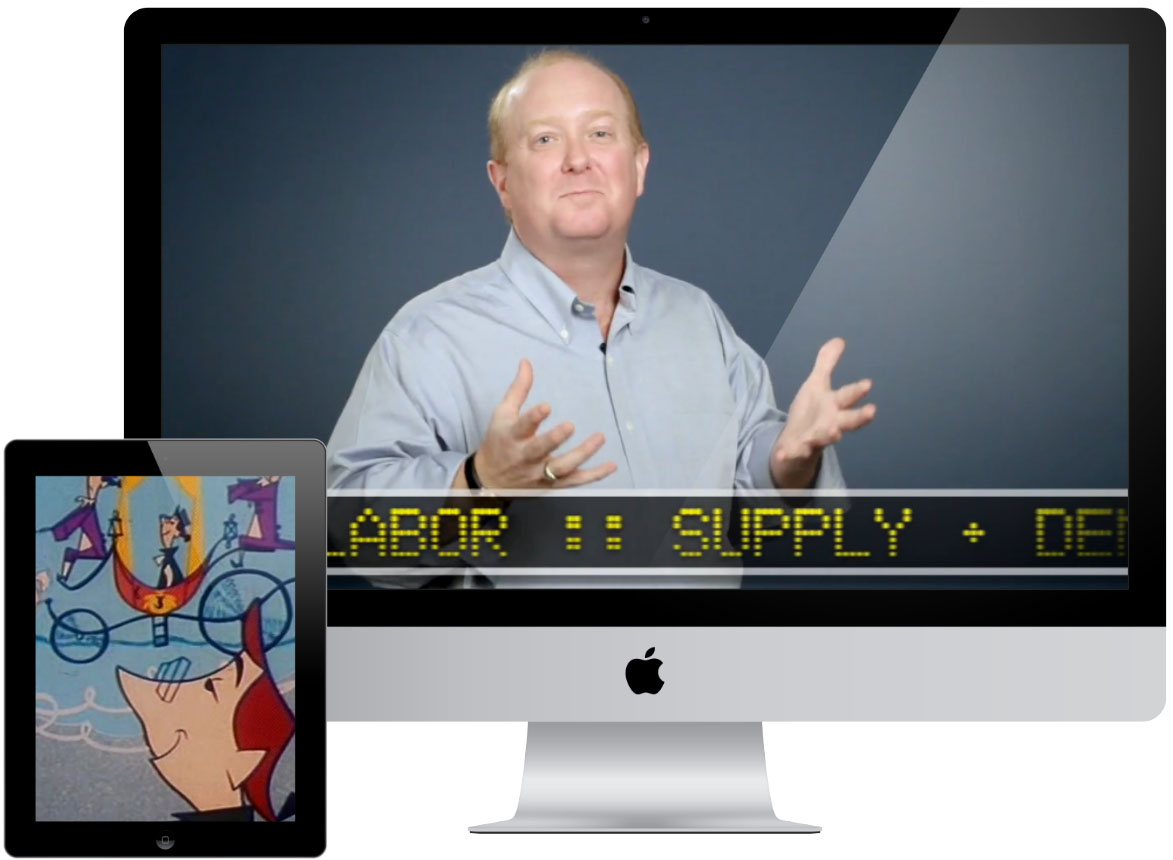
If you want a quick overview of the entire product, listen to R.C. Sproul Jr. explain it in under two minutes.
1. Why a biblical starting point changes everything
Here is where a Christian economics curriculum for homeschool does something no secular course can do.
The first and most basic economic principle isn’t supply and demand. It’s “The earth is the Lord’s, and the fullness thereof.” (Psalm 24:1)
God owns everything; we are merely His stewards. That one idea, taken seriously and followed consistently, produces a completely different approach to economics than anything you’ll find in a standard textbook. A stewardship-based economics curriculum starts here, and everything else flows from it.
Work is a participation in God’s creative mandate, something purposeful and good from the beginning. Property rights are a reflection of how God structured creation. The free market is the system most consistent with how human beings are actually made, as individuals with agency, creativity, and the capacity to serve one another through voluntary exchange. A society that orders itself around these principles tends toward liberty and prosperity. A society that ignores them pays a price.
Understanding this is what makes biblical economics for homeschool families so different from a standard economics class. Economics is an essential part of our world, and seeing it from a biblical perspective will transform how your student understands history, government, and the way nations rise and fall.
2. The connection most economics courses miss
In the years I spent researching this course, I kept coming back to a connection I had never seen laid out clearly in any standard economics textbook: free societies with economic liberty tend to support the growth of the Church, both at home and through missions abroad.
When economic and moral laws are followed, a society generates the kind of prosperity that frees people to pursue things beyond basic survival: art, learning, worship, and giving. That prosperity funds the work of the Kingdom in ways that impoverished societies simply cannot.
Boston University researchers estimate that the Christian community in China has grown from approximately 1 million to around 100 million over the past forty years. South Korea (itself evangelized by Western missionaries) is now one of the world’s largest missionary-sending countries. Free societies and growing churches have gone hand in hand throughout history, and they still do.
This is why studying economics is a matter of discipleship for a Christian student. God expects us to use the prosperity He gives us for the growth of His Kingdom, both locally and abroad. Understanding economics helps us fulfill the Great Commission.
3. How Economics for Everybody compares to other options
There are several solid economics curricula for homeschooling families. If you are looking for a free market economics curriculum for homeschool that takes the biblical worldview seriously, these are the main options worth considering. Here is an honest look at each one.
1. Whatever It Takes Economics
Whatever It Takes is a workbook-based economics text with a Christian perspective. It covers the standard topics (supply and demand, market structures, fiscal and monetary policy) in a format many co-ops find easy to schedule. The approach is conventional and text-driven, focused more on economic mechanics than on the theological foundations behind them.
Choose Whatever It Takes if: your student needs a standard textbook structure or you’re teaching in a co-op with set lesson formatting.
2. Notgrass Exploring Economics
Notgrass Exploring Economics is a well-regarded one-semester course with a Christian worldview emphasis. The writing is clear and conversational, covering both microeconomics and macroeconomics through a biblical lens. It is a reading-based curriculum with no video component, so families who learn well from books will appreciate it. Families already using Notgrass for history will find the pacing familiar. You can find Notgrass Exploring Economics here.
Choose Notgrass if: your family is already in the Notgrass ecosystem, or your student learns better from reading than from video.
3. Christian Economics by Gary North
Gary North’s Christian Economics is a thorough, theologically serious treatment of economics from a Reformed perspective, available as a free download. I actually used a number of Dr. North’s books in developing this curriculum. He is one of the most important Christian economists of the 20th and 21st centuries. He can sometimes be difficult to follow, especially for younger students, but the content is rigorous and serious.
Choose Christian Economics if: your student is a strong independent reader who wants to go deep into the theological foundations.
Economics for Everybody — A Different Kind of Course
Economics for Everybody takes a different approach from any of the above.
R.C. Sproul Jr. has spent his academic career studying the intersection of Christian theology and economic theory, and he has a gift for making that connection clear without making either one shallow. He is, in the best sense of the phrase, a teacher who enjoys what he is teaching, and that enjoyment is contagious.
I set out to build a course that would reflect his deep knowledge and love of economics and theology. It’s a course that starts with God’s ownership of the world and works outward from there. Every concept in the course flows from that foundation.
The production is equally distinctive. This is a Compass Cinema production (I wrote and produced the series), and I made it with the same care I try to bring to everything we produce at Compass. The visual materials, the film clips, the historical photographs, the animated sequences, all serve the teaching directly. We illustrate supply and demand with Charlie Chaplin films and explain the history of money with cartoons. Our goal was to make economic ideas vivid, understandable, and fun.
When R.C. Sproul Jr. explains what inflation does to savings, you see it in the faces of people who lived through the Weimar Republic. When he explains the difference between free markets and command economies, you see North and South Korea from a satellite: the same people, the same peninsula, one side lit and one side dark. Some things are best understood visually, and we built the course around that idea.
The course was developed with input from a distinguished advisory team: Shawn Ritenour, Ph.D. (primary advisor), E. Calvin Beisner, Ph.D. (author of Prosperity and Poverty), Paul Cleveland, Ph.D. (co-author of Basic Economics), Robert Murphy, Ph.D., Gary North, Ph.D., and Lawrence Reed.
“Economics for Everybody is really more than just an economics course: it’s economics meshed with Biblical theology and a smattering of history thrown in for good measure.”
Trisha
“This is a hidden gem — I can’t believe this hasn’t gotten more attention. This is a 12-week overview of economics that can be easily taught in less than an hour for each session.”
2023 reviewer
Choose Economics for Everybody if: you want your student to understand why the biblical worldview leads to different economic conclusions than the alternatives, where those conclusions come from, and why they matter for the Christian life and for the world.
4. What the course looks like in practice
The course covers 12 lessons in sequence, beginning with foundational principles then building up into complex economic systems. The early lessons establish the biblical framework: God’s ownership of creation, the stewardship mandate, and what it means for human beings to be economic actors made in God’s image. From there the course moves into free market principles: how prices work, what entrepreneurs do, why voluntary exchange benefits both parties. The middle lessons address what goes wrong when principles are violated: inflation, interventionism, the welfare state, corporatism. The final lessons bring everything together and ask what a kingdom-shaped economics looks like in practice.
The video lectures work together with the study book, which I wrote to go deeper than the videos can in 15 to 20 minutes. Each concept is explored in greater detail and applied to the real world.
“Economics for Everybody provides a relevant, engaging, and clear presentation of key economic principles using lively explanations and practical examples, fun video clips of silent films and cartoons, and sobering images of the consequences of socialism, interventionism, and communism in history.”
Brandy
Once you enroll, everything lives inside the Compass Classroom learning platform in a single organized sequence. Each lesson walks your student through the same steps: watch the video, read the study book chapter, complete the questions, work through the discussion questions. The platform keeps track of progress, so it’s easy to pick up where you left off. The course is entirely self-paced.
I’m genuinely pleased with how well this course works in a group setting. The discussion questions were written with group conversation in mind, and economics comes alive when people wrestle through the ideas together. The course works equally well for homeschool co-ops, small groups, Sunday school classes, and family study. If you’re teaching more than one student, group and co-op licenses are available.
5. Taking the Course
- 12 video lectures: 15 to 27 minutes each, approximately 4 hours of video total
- 266-page digital study guide: PDF, EPUB, and MOBI formats; includes multiple choice questions, short answer questions, discussion questions, and a full answer key
- Printed study guide: available as an optional add-on
- Basic Economics by Carson and Cleveland: optional companion textbook for families pursuing a full credit
- Optional grading service: assignment submission, instructor feedback, and a transcript-ready grade
Age: 14 and up. Accessible for motivated middle schoolers; well-suited to high school students ready to think seriously about economic policy and its biblical implications.
Credit: ½ or 1 HS Economics (or Social Studies). The course alone is commonly listed as a half credit; paired with Basic Economics it typically counts as a full credit.
Access: 1 year of streaming from purchase date.
“I highly recommend Economics for Everybody for any middle schooler, high schooler, or adult who wants a solid understanding of economics.”
Debra
“He explains economics in a way that allows students to relate to the information, using practical examples.”
Heather
6. About R.C. Sproul Jr.
R.C. Sproul Jr. holds a doctorate in theology and spent years teaching philosophy and theology at Reformation Bible College. Economics has been his primary academic interest since college, not because he ever separated economics from theology, but because he never did. His conviction is that the Christian worldview, taken seriously, has specific and consequential implications for how we think about markets, money, property, and stewardship. Those implications deserve to be taught.
7. Frequently Asked Questions
What age is this course designed for?
14 and up, though motivated middle schoolers can handle the material. It works well for high school students at any grade level.
Is this a full economics credit?
It can be. Families who use the course alongside the optional Basic Economics textbook typically list it as a full credit. The course alone is commonly listed as a half credit.
Does this cover personal finance as well as economics?
It covers economic principles: how markets work, what money is, what inflation does, why some economies flourish and others fail. For practical budgeting and money-management skills, Ramsey’s Foundations in Personal Finance is a natural complement.
How is this different from a secular economics course?
The starting point is different. This course asks what it means for human beings made in God’s image to be economic actors in a world God owns. That question leads to different answers, and those answers have real consequences for how students think about freedom, government, and stewardship for the rest of their lives. Although economists like John Maynard Keynes are explained in this course, Keynesian economics is not taught as a framework to follow.
What is the relationship with Austrian economics?
This course employs some aspects of Austrian economics as the best secular comparison to Christian economics. Austrian economics gets a great deal right: its emphasis on human action, spontaneous order, and the limits of central planning aligns well with what Scripture teaches. However, Austrian economics derives its conclusions from human action alone, not from biblical revelation. This course grounds its principles in the way God created man, his fallen nature, and the role of law and redemption in establishing flourishing societies.
Can my student complete this course independently?
Yes. The video lectures, study guide, and discussion questions are all designed for independent study. A parent who works through the discussion questions alongside the student will get a great deal out of it, and that is always welcome.
Does Compass Classroom offer grading for this course?
Yes. Optional grading can be added at the time of purchase or afterward.
8. Help your student understand the world they’re inheriting
Here’s what’s encouraging in the midst of the modern confusion surrounding economics: the principles that lead to flourishing are plainly explained in Scripture. They are consistent with how God made humans in His image. They have worked everywhere they have been faithfully applied, and they can work again. Our children do not have to repeat the mistakes of past generations. They can understand economics the right way from the beginning.
That is what this course is designed to do. A student who grasps Christian economics is better prepared for college, for work, and for citizenship. More than that, he is prepared to be a faithful steward of whatever prosperity God entrusts to him and to use it for the growth of the Kingdom.
The next generation can do better than ours. Give them the foundation to do it.
→ Try Free Lessons — Economics for Everybody
→ View the Economics for Everybody Product Page
If you’d like to watch a full lesson from the series, here’s the first one. We hope you really enjoy it.